
Onondaga County Court Records After Arrest
The local path is arrest, jail booking, first court step, prosecutor action, and then a court case record. The Justice Center booking section creates the intake record when a person is brought under arrest or committed by an Onondaga County court. After that, the court side depends on the charge, court, and location. Syracuse misdemeanors route to Syracuse City Court. Misdemeanor and traffic cases outside Syracuse route to the related town or village court. Felonies route to Onondaga County Court, although a new felony may wait for grand-jury action before assignment to a County Court judge.
Booking and court records are not the same record. The roster can help confirm custody, facility, name spelling, ICN, VINE linkage, and sometimes court or bail information. The court record shows the filed charges, hearings, charge changes, warrants, disposition, and sealing status when public. For custody details, use Onondaga County jail inmate records. For booking-photo issues, use Onondaga County jail mugshots. The court record remains the better source for what the prosecutor filed after arrest.
Search Court Records After Arrest
New York Courts WebCriminal Defendant Search is the main online case-search channel for criminal cases. It can be searched by defendant information, case or summons identifiers where supported, and court calendars. The portal requires JavaScript. If the person was just booked, the case may not appear at once, especially when a felony complaint is awaiting grand-jury action.
- Start with the county jail lookup and copy the defendant's name spelling, facility, ICN, and any court or bail detail.
- Open WebCriminal and search by defendant name if no case number is known.
- Check the likely court: Syracuse City Court for city misdemeanors, the local town or village court for non-Syracuse local cases, or County Court for felonies.
- Read the charge list, hearing dates, warrant notes, and status fields as court allegations, not convictions.
- Contact the clerk when the case is new, older, sealed, local, or missing from the online portal.
The WebCriminal defendant search source shows the court portal used for criminal defendant and calendar searches.
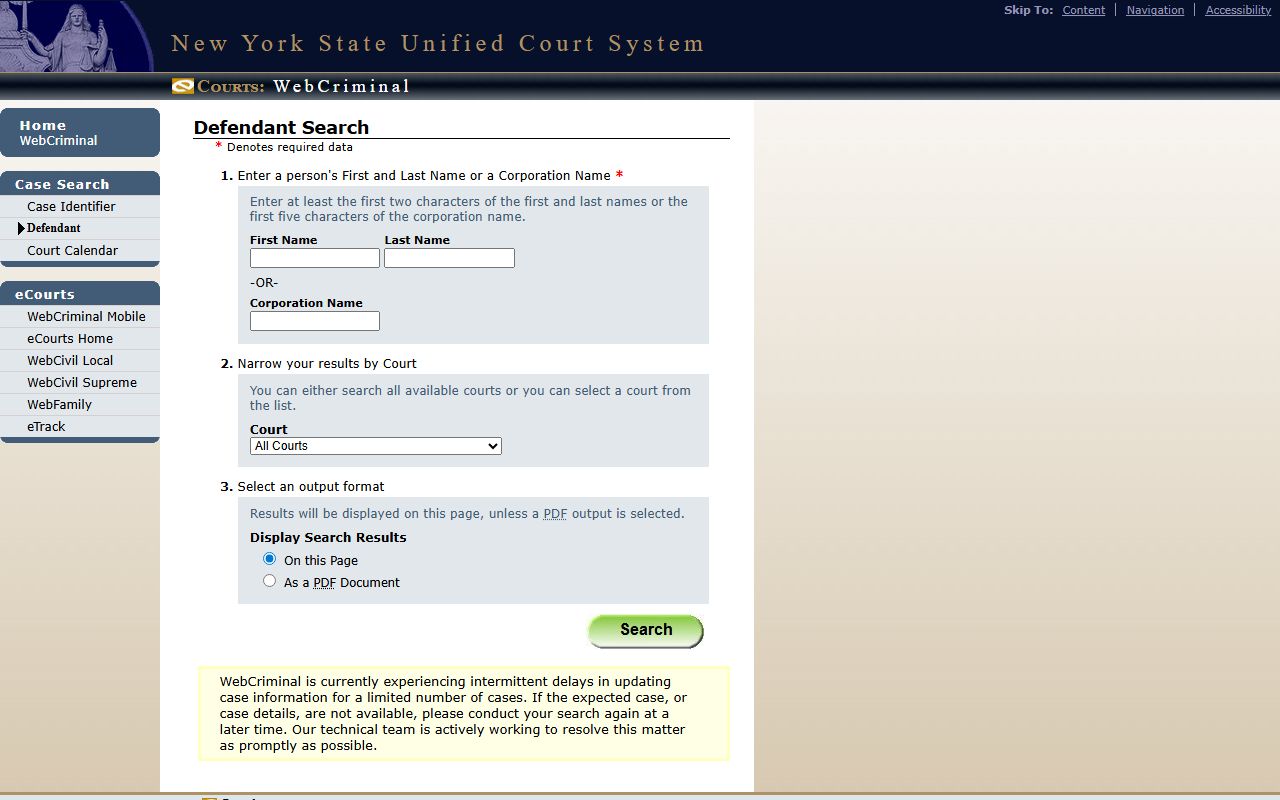
The image supports the court-search channel, but the clerk remains important when WebCriminal does not display the record.
Onondaga County Arrest Court Routing
The Justice Center Oversight Committee gives practical local routing. Syracuse City Court Criminal Clerk handles misdemeanor cases in Syracuse at 315-671-2760. Misdemeanor and traffic offenses outside Syracuse route to the relevant town or village court. Felonies route to Onondaga County Court Clerk at 315-671-1020. If a felony case is awaiting a grand-jury decision, it may not have a County Court judge until the grand jury reports an indictment. After indictment, the defendant is re-arraigned before the County Court judge who will hear the case.
| Case Type | First Place to Check | Local Detail |
|---|---|---|
| Syracuse misdemeanor | Syracuse City Court Criminal Clerk | Use 315-671-2760 for clerk routing. |
| Town or village misdemeanor/traffic | Related town or village court | Use the court for the place where the offense was charged. |
| Felony | Onondaga County Court Clerk | Use 315-671-1020, but grand-jury cases may not be assigned yet. |
| County Criminal or Supreme Court records | Onondaga County Clerk | The County Clerk is the public record holder for listed legal documents. |
Charging Documents After Arrest
The charge named at booking is an arrest or custody entry. The filed charge is the court accusation that moves the case. The Onondaga County District Attorney, led by William J. Fitzpatrick, decides what charges to prosecute in felony and many misdemeanor matters, reviews police reports and evidence, and presents felony matters to a grand jury when indictment is required. This is why a jail charge and a later court charge may not match exactly.
| Document | Who Uses It | Common Role | What to Verify |
|---|---|---|---|
| Complaint | Police, complainant, or prosecutor process | Starts many criminal cases after arrest. | Charge title, statute, and next appearance. |
| Information | Prosecutor or local criminal court process | Used in many misdemeanor matters. | Whether the complaint was converted or amended. |
| Indictment | Grand jury | Formal felony accusation after grand-jury action. | Counts, arraignment after indictment, and assigned judge. |
Charge Status in Court Records
Court charges change as the case moves. A prosecutor may add, reduce, amend, supersede, or dismiss counts. A grand jury may indict on different counts from the original felony complaint. A plea or verdict can resolve one count while others are dismissed. Read each status as part of a timeline, not as a final background-check conclusion unless the disposition is clear.
| Status | Meaning in Plain English |
|---|---|
| Pending | The charge is still open and has not reached final disposition. |
| Amended or reduced | The filed charge changed from the earlier arrest or complaint version. |
| Dismissed | The court no longer proceeds on that count, subject to record-sealing rules. |
| Indicted | A grand jury returned felony charges for County Court handling. |
| Disposed | The count has an outcome, such as plea, verdict, dismissal, or other order. |
Bail Records After Arrest
Bail information can bridge jail records and court records. The Justice Center Bail Cashier/Money Drop-off Window accepts in-person bail payments in cash, credit card, and official bank check payable to the Onondaga County Sheriff's Office, with bank checks limited to banking hours for verification. A valid photo ID is required. The payer receives a receipt that lists the incarcerated person's return court date, time, and court. Once bail is paid, the money is forwarded to the court handling the case.
| Release or Hold Issue | How It Works |
|---|---|
| Cash bail | Money is paid to secure later court appearances when bail is legally set. |
| Release on recognizance | The person is released on a promise to return, with no money bail. |
| Remote bail | GovPayNet remote bail services require court and detainee details such as PLC code, DR number, ICN, court, and judge. |
| Hold or detainer | A parole, federal, immigration, state-ready, or other-jurisdiction hold may block release even if one case is bailed. |
Note: A bail receipt can identify the next court, but it is not a full court file or final charge disposition.
Warrants and Arrest Records
The sheriff maintains an Active Warrant Search with A-Z browsing, last-name search, and a Submit button. A public active warrant entry can lead to arrest, booking, and then court handling. Not every warrant appears in the sheriff search. Bench warrants from town or village courts may be held at the court level or entered into law-enforcement systems without a public web entry. The Warrants Investigation Unit phone listed by the sheriff is 315-435-3032.
Do not treat a warrant search result as a conviction. It is a court or law-enforcement command tied to an unresolved issue. For a warrant tied to an open criminal case, WebCriminal and the issuing court may show calendar or status information. If a warrant comes from another county, state parole, federal authorities, or immigration custody, local bail in one case may not end all holds.
Charges vs Convictions
An arrest and a filed charge are accusations. A conviction exists only after a plea, verdict, or qualifying final disposition. That distinction matters in Onondaga County because jail roster charges, prosecutor-filed charges, indictment counts, and final dispositions can be different records at different stages.
| Point of Comparison | Charge | Conviction |
|---|---|---|
| Stage | Accusation after arrest or prosecutor filing. | Final outcome after plea, verdict, or qualifying disposition. |
| Proof level | Based on arrest, complaint, information, or indictment standards. | Requires guilty plea or proof beyond a reasonable doubt at trial. |
| Public meaning | Shows what was alleged. | Shows the court outcome, unless sealed or restricted. |
Sealed Court Records After Arrest
New York records often use sealing rather than broad public expungement language. Criminal Procedure Law section 160.50 provides sealing after termination of a criminal action in favor of the accused, with notice to criminal-justice agencies. Sealing can restrict public access to official records after a qualifying dismissal or other favorable termination. It does not mean a person should rely on a casual web search to know what a court, agency, or regulated background-check process can see.
| Issue | Sealed | Expunged |
|---|---|---|
| Public visibility | Restricted from ordinary public access by law or court order. | Often used to mean destroyed or treated as gone, but New York sources here focus on sealing. |
| Trigger | May apply after termination in favor of the accused under CPL section 160.50. | No local county mugshot-removal shortcut was documented. |
| Where to verify | Court clerk, County Clerk, or counsel. | Court order or statute, not a private request to a search site. |
CHRS and Restricted Records
NY Courts publishes guidance for court records, clerk requests, and the Criminal History Record Search program. The court system states that each CHRS search costs $95. CHRS is a statewide court-record search, not a jail roster and not a substitute for the local court file. Courts are generally public under Judiciary Law principles unless sealed, while executive agency records such as sheriff booking records use FOIL. That split explains why a court case request and a Sheriff's Office FOIL request go to different places.
Important: Court, jail, and warrant records should be verified with the originating clerk or agency before any legal or regulated decision.